
We were building Chess Lens, an educational chess assistant that could look at a board position and help guide a player through it.
The idea was to use VideoDB to ingest the chessboard visually, follow the game state over time, and turn the current position into structured data for teaching, analysis, and next-move guidance. Before any of that could work, the system needed to read the board accurately.
To validate that board-reading step, we evaluated different thinking configurations for GPT-5.4 and Claude Opus 4.7 on the same board-reading task. Claude Opus 4.7 consistently trailed the strongest GPT runs, so we looked more closely at where its outputs were failing.
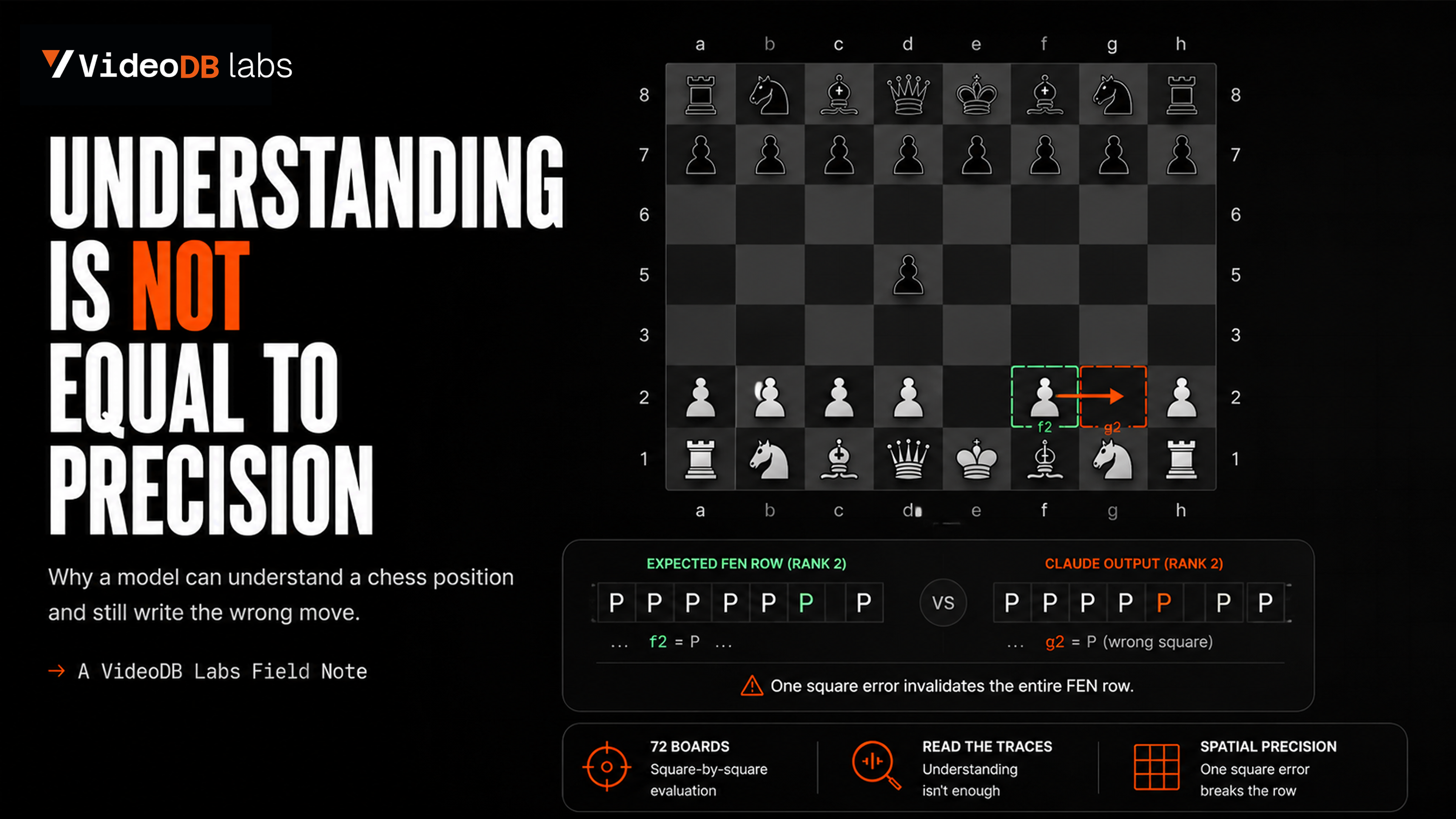
FEN and what we measured
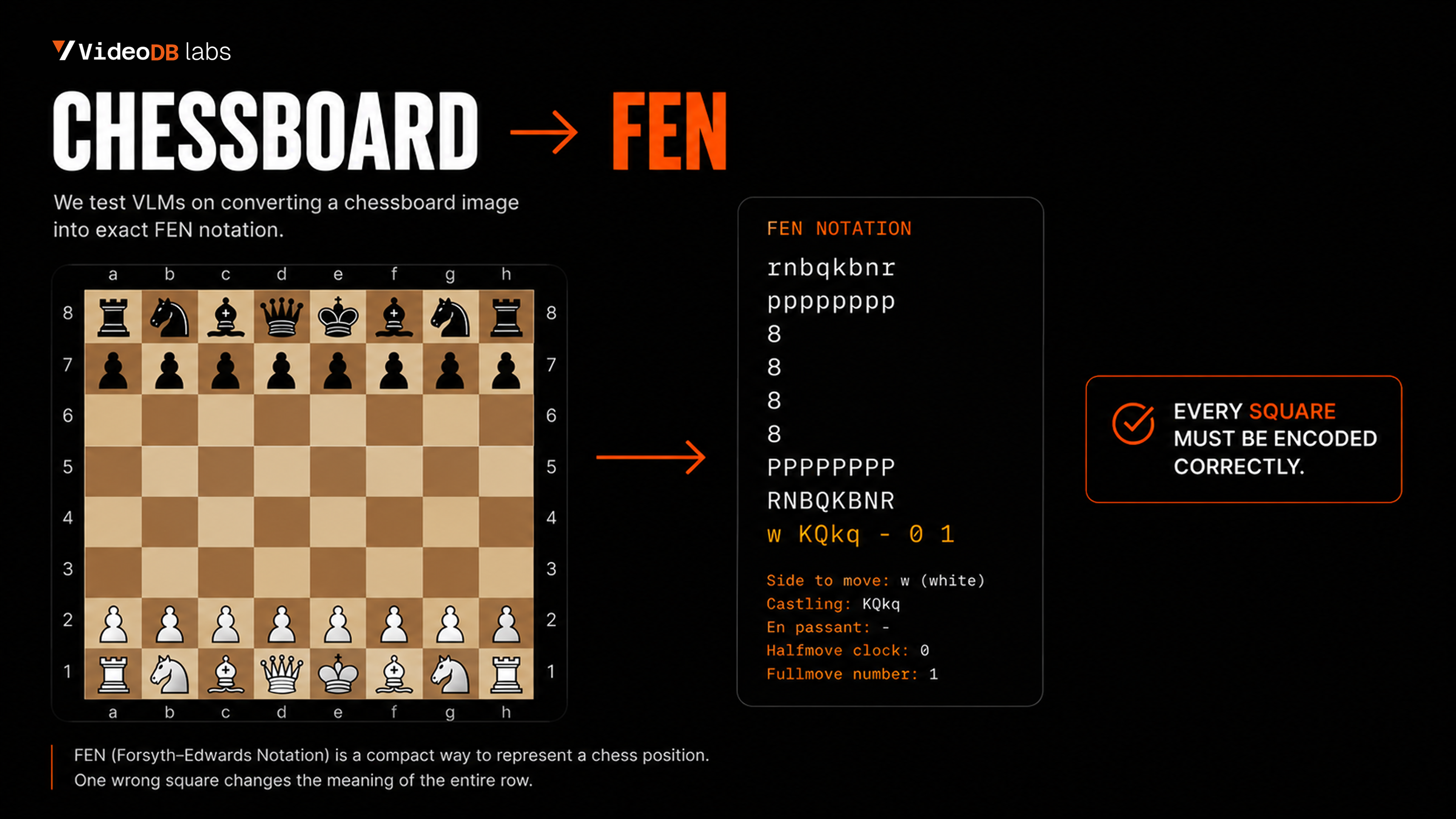
Chess Lens needed the current board position in FEN, a standard notation for one exact chess position. FEN records the board as rows of piece letters and empty-square counts. For example, a row like PP3P2 means two white pawns, three empty squares, one white pawn, and two empty squares.
For this evaluation, we only measured the piece-placement field of FEN. The model received a board image and had to return which piece was on which square. We compared that output against the expected FEN for the same point in the game.
That makes the evaluation strict in the way Chess Lens needs it to be strict. If a pawn is shifted from one file to the next, the position may still look plausible in prose, but the FEN is wrong.
Setup
We evaluated a chess game across 72 board positions. Each evaluated model had to determine board orientation, identify every visible piece, assign each piece to a square, and emit the piece-placement field of FEN.
The score is exact-match accuracy against the expected FEN sequence for the game.
Token budget changed the result
The first run used a 1024-token output limit. That was too low for high-reasoning configurations, so some models ran out of tokens before producing the final structured answer.
| Run | Accuracy | Exact / Eval | Notes |
|---|---|---|---|
| GPT-5.4 low summary | 100.00% | 72 / 72 | best overall |
| GPT-5.4 default | 93.06% | 67 / 72 | no reasoning summary |
| Claude Opus 4.7 xhigh summary | 76.39% | 55 / 72 | 6 parse errors |
| Claude Opus 4.7 high summary | 69.44% | 50 / 72 | 4 parse errors |
| Claude Opus 4.7 default | 66.67% | 48 / 72 | 1 parse error |
| GPT-5.4 xhigh summary | 4.17% | 3 / 72 | 69 parse errors |
| Claude Opus 4.7 max summary | 2.78% | 2 / 72 | 70 parse errors |
The low scores for GPT xhigh and Claude Opus 4.7 max were mostly truncation failures, not vision failures. The models used too many tokens and often did not reach the final answer.
We increased the output limit to 4096 tokens and reran the evaluation.
| Run | Accuracy | Notes |
|---|---|---|
| GPT-5.4 low summary | 100.00% | best overall |
| GPT-5.4 default | 97.22% | strong, no summaries |
| GPT-5.4 xhigh summary | 94.44% | strong but expensive, still some parse errors |
| Claude Opus 4.7 max summary | 84.72% | best Claude Opus 4.7 run |
| Claude Opus 4.7 high summary | 80.56% | no parse errors, still mapping mistakes |
| Claude Opus 4.7 xhigh summary | 79.17% | similar to high |
| Claude Opus 4.7 default | 63.89% | weaker without thinking |
| Claude Opus 4.7 medium summary | 58.33% | worst Claude Opus 4.7 config |
Aggregate scores were not enough
Claude Opus 4.7 improved after increasing the token budget, especially at max thinking. But the accuracy still did not catch up to GPT.
That pushed us to inspect the intermediate reasoning summaries and failed outputs instead of relying only on aggregate accuracy.
GPT's reasoning summaries usually stayed procedural and row-specific:
For row 8, I see: a8 has a black rook, f8 has a black rook, h8 has a black king...
Moving to rank 2, I see the white pawns at a2, b2, c2, with gaps where pieces have moved...
Claude Opus 4.7's reasoning summaries were more often global descriptions of the position:
I'm looking at a chess board layout with pieces positioned across the rows, showing what appears to be a mid-game or puzzle position...
Black has pawns scattered across the board with the king on f6, white has a rook on d1, a king on e3, and a few pawns positioned strategically.
This helped explain the remaining errors. Claude Opus 4.7 usually understood the board as a chess position, but it was less reliable at preserving the exact square-by-square layout.
The failure pattern
Manual inspection showed mostly local errors: pieces shifted by one file, one extra or missing empty square in a row, moved-pawn gaps missed, correct piece family but wrong square, or correct piece but wrong color or case.
For example:
| Expected | Claude Opus 4.7 Output | What Went Wrong |
|---|---|---|
p1b1pk2 |
p2b1pk1 |
empty-square counts shifted |
PP3P2 |
PP4P1 |
pawn moved one file over |
1BNP1N1P |
1BNB1N1P |
wrong piece at a specific square |
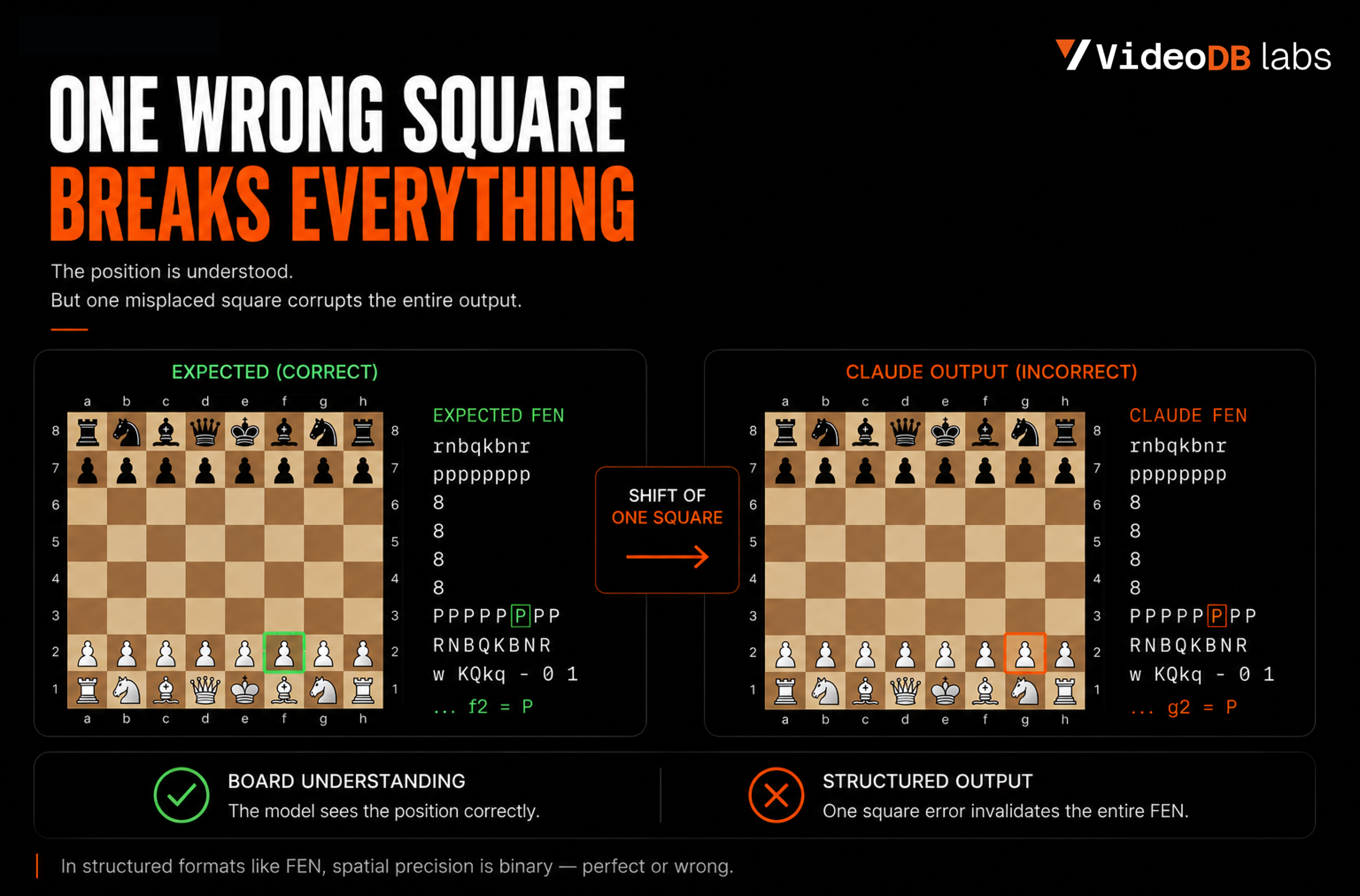
That pattern matters because FEN compresses each row using piece letters and empty-square counts. For example, PP3P2 means two pawns, three empty squares, one pawn, and two empty squares. If Claude Opus 4.7 outputs PP4P1, the row still looks plausible, but the pawn has shifted by one file and the FEN is wrong.
Claude Opus 4.7 was not failing at general chess understanding. It was failing at precise spatial localization.
The documented limitation
This matches the Claude vision documentation:
Spatial reasoning: Claude's spatial reasoning abilities are limited. It may struggle with tasks requiring precise localization or layouts, like reading an analog clock face or describing exact positions of chess pieces.
Source: https://docs.anthropic.com/en/docs/build-with-claude/vision
That line maps closely to this experiment. FEN generation requires exact localization across 64 squares. If a model recognizes the board but shifts one piece by one file, the FEN is still wrong.
Takeaway
Chess Lens exposed a narrow but important failure mode: understanding the board is not enough when the output format requires exact coordinates.
Claude Opus 4.7 often produced outputs that looked reasonable at the position level, but FEN is evaluated at the square level. One shifted piece changes the board state. One wrong empty-square count changes the row. The model can be directionally right and still fail the task.
The takeaway is that downstream tasks need their own evaluations. The best general-performing model is not automatically the best model for the specific task you are trying to solve.